Funhouse at Versailles
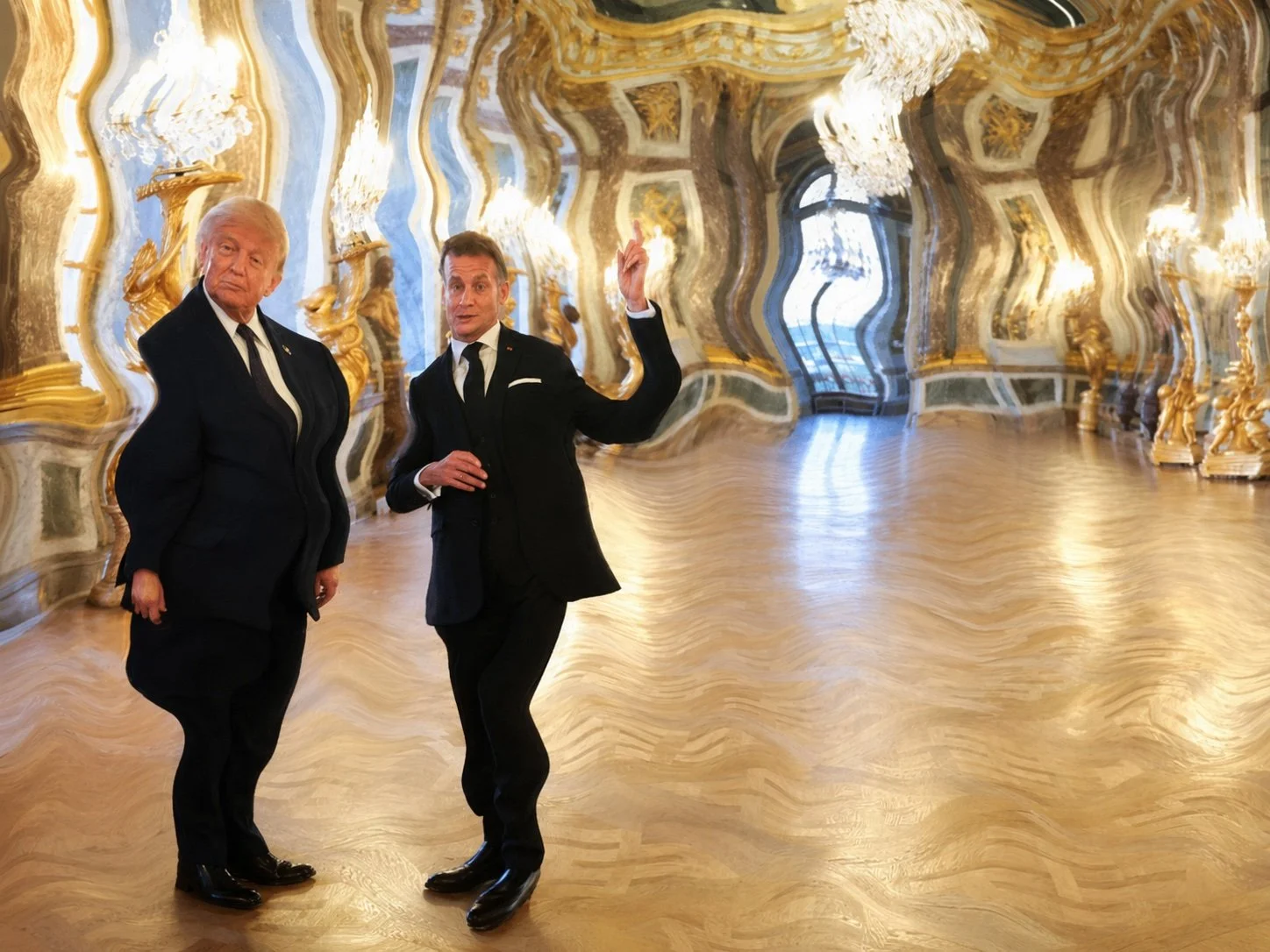
The Hall of Mirrors has a way of not only magnifying the look of things but also distorting them. Macron hosted Trump at Versailles today, not at a chateau, but a funhouse.
Trump needs to take a close look in the mirror, but in just one and preferably while at home alone. He doesn’t need to see himself in over 350 of them in the Hall of Mirrors at Versailles while accompanied by French President Emmanuel Macron and the media. When Macron regaled Trump with a state visit at the palace after the G7 summit in Evian, he thought he was exercising soft power in regaining Trump’s respect after a tumultuous start to his second term.
But Trump has already thrown more cold water than in Evian on that prospect. It’s unlikely he’ll remove his tariffs on French imports or re-engage the United States with France and the European Union and NATO. Trump is all too willing to drop allies and supporters in a heartbeat when it suits him. That’s because there’s a long line of sycophants ready to take their place. On that note, Versailles is actually a befitting place to take someone who acts like French kings once did.
To Macron’s credit, Versailles was not a bad choice for venue this time since he’s already feted Trump in Paris before. The Arc de Triomphe was so impressive that Trump now wants a similar arch in Washington. The Eiffel Tower might have fared less well, it being a triumph of science, and Trump hasn’t shown much interest in triumphing science lately. However, he was perfectly happy to attend the re-opening of Notre Dame cathedral even if his preferred house of worship is the White House where the guests come to worship him.
Macron has also taken Trump to the military parade on Bastille Day. This time around, Macron should have taken Trump instead to eponymous square in Paris, a sure reminder that the people who are unhappy with their leader can rise up at any moment and demand blood. (An even better reminder is at the Place de la Concorde where the most heads fell to the guillotine during the Revolution.) General Lafayette even gave the keys to the Bastille prison to his old protégé and wartime hero, George Washington. As if there could be a better reminder of the 250 years of Franco-American friendship.
Or why not take Trump to the Place de la République as some on the French left called for? At least there, Trump could marvel at the very symbol of the French republic, Marianne, perched high up looking out upon her the citizens. She reminds us that France today is indeed a republic, no longer a kingdom or an empire. By bringing Trump to Versailles, Macron took the opposite track, vainly flattering the president of the United States with forms of grandeur America was never designed to have. In fact, it fought for independence from precisely that old form of government. Not that Trump likely picked up on this lesson. The Hall of Mirrors has a way of not only magnifying the look of things but also distorting them. Macron hosted Trump at Versailles today, not at a chateau, but a funhouse.
The Palace Became a Circus
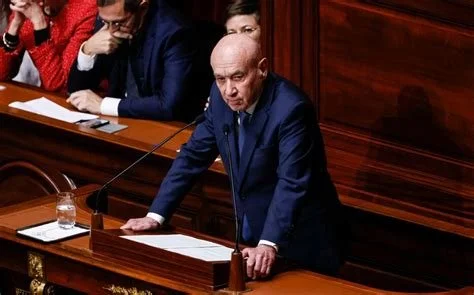
French Senator, Claude Malhuret, elevates his critique of Trump and his administration to an art form. While he caught the eyes of many in the American press for the most biting remarks, the full speech captures the urgency of reforms in France and Europe in order to contend with the new world order.
There are times critics from France sum up succinctly the current problems of the Trump administration. Senator Claude Malhuret of the center-right party, Horizons, elevates that critique to an art form. Last year, he gave an eloquent speech comparing Trump to the tyrannous Roman emperor Nero. This year, Malhuret returned with an acerbic Senate floor speech that outdid himself. While he caught the eyes of many in the American press for the parts mocking Trump and his administration, the full speech captures the urgency of reforms in France and Europe in order to contend with the new world order.
Malhuret’s speech of March 27, 2026 is available in French in its entirety on the Public Sénat website. I will not comment on his commendable speech, but humbly offer a translation of it in the hopes of having done it justice. I did add in brackets some explanatory text for the non-Francophone reader or for clarification. The eloquence in French is all his; any shortcomings in the translation are of course mine.
Mr. President, Mr. Prime Minister, Ladies and Gentlemen Ministers, in February 2022, a dangerous madman drunk on grandeur lit a fuse in Ukraine which exploded a barrel of gunpowder and wreaked havoc on the world order. The war was supposed to last a week. It is entering its fifth year.
In February 2026, another dangerous madman lit another fuse in the Middle East which called into question once more the international balance. That war was also supposed to last a week. A month later, the whole world is asking the question: What’s going to happen? The answer, simple, short, and precise is the following: God only knows.
Here a year ago today, I compared the Trump presidency to the Court of Nero. I was wrong. It’s the Court of Miracles [parts of 17th-century Paris where beggars pretending to be ill resided and disappeared at night “as if by miracle”]. An antivaxxer and former heroin addict is Health Secretary [Robert F. Kennedy, Jr.], a climate skeptic head of the Environmental Protection Agency [Lee Zeldin], an alcoholic TV personality is Defense Secretary [Pete Hegseth], a former agent for Qatar is Attorney General [Pam Bondi], and a Putin groupie is Director of Intelligence [Tulsi Gabbard]. A Turkish proverb says, “When a clown moves into a palace, he doesn’t become king. The palace becomes a circus.”
This fine team decided to create a competitor to the United Nations. Since its Board of Peace has been around, Trump has launched more military strikes than Biden during his entire term. Each time the Epstein affair comes back up, the bombs explode in some part of the world and create a diversion. Bomb more to earn more. There isn’t a country where Trump hasn’t profited from the situation to enrich himself, and let’s not forget his family. Personal Boeing gifted by Qatar, investments in every Gulf project or elsewhere, manipulating stock prices which insiders benefit from. Just one of his conflicts of interest would have prompted an immediate procedure for removal of office here. But we’re not here. We’re in MAGA America, the conduct of public affairs in the service of private interests.
After the tariffs, Greenland, deserting Ukraine, humiliating allies, the ineffective back and forth with Venezuela, and many others, a new senseless adventure begins. So I’m not misunderstood: I am the last person to complain about the beheading of the mullah regime [Islamic Republic of Iran] and the first to demand freedom for the Iranian people. But what is the strategy to reach it? Has the collateral damage, including for the Iranians, been measured? The answer is there is no strategy and the collateral damage has been written off. Just like in January, Trump called for Iranians to take to the streets only for them to then be massacred by the Basij [volunteer paramilitary force within the Islamic Revolutionary Guard].
After the pretext of an imminent nuclear threat from Iran, contradicted by the Director of Intelligence herself, then the argument for regime change, it was Marco Rubio who spilled the beans. We went there because we followed Netanyahu. In other words, we have no objective of our own. Trump dismissed the warnings from the rare few who had the courage to tell him what was obviously going to happen: the closing of the Strait of Hormuz, the widening of the war across the entire Middle East, and finally the fall-out the whole world over.
In the latest fake news, the only goal of which was to calm oil prices and falling stock markets, he announces that negotiations are underway. The president of the Iranian parliament refutes this in the hours that follow. It’s the first international negotiation where one of the parties finds out it’s negotiating by watching the news on TV.
Oil tankers are blocked in the Gulf. The United Arab Emirates are closing their airspace. Influencers on the beach in Dubai are begging to be repatriated. Refineries and oil fields are on fire.
After having assembled the strongest army in the world, failed to win a war against a middle power, blew up the price of oil and gas, and held speeches one couldn’t make heads or tails of, the golfer from Mar-a-Lago shamelessly admits to being surprised by Iranian counterattacks—which were perfectly predictable—and calls for help from allies he was insulting the day before. And they answered: “You consulted no one. You have no plan. And we have no reason to follow you blindly into the dark.”
Trump, the only bull in the world who goes around with his own china shop, has nothing left but two bad choices, one as bad as the other: pitifully withdraw while claiming no one had attained their objectives or escalate with results that have been known since Vietnam, Iraq, Afghanistan: stalemate and in the end a shameful departure leaving a free rein to the Communists, the Islamic State, or to the Taliban.
Europe’s problem is that we can’t stop a disaster with pretty statements while pleading with Israel and Hezbollah to put aside their arms while declaring that Hormuz is not our war. It’s true but that only underlines our powerlessness. In the short term, France’s position is the right one. We will not participate in an offensive without an aim, a strategy, and a clear view. But we will maintain our international engagements that protect our allies in the Gulf and in the Mediterranean while being ready to take part in the free movement in the strait because we are the only European country to have kept its air and sea forces operational. This position has to be upheld.
But the twenty-seven [member states of the European Union] are also going to have to begin to solve their urgent and serious problems. The wars in Ukraine and the Middle East are sending us a plain and simple message: we can’t rely on ourselves. De Gaulle understood it first sixty years ago. His message has been forgotten by Europeans. It has been more than enough time to reconsider it. Europe has three major challenges: guarantee its own security, produce an efficient decision-making system, and become part of the great technological, cognitive, and financial revolution of the 21st century. Otherwise, the alternative will be simple: subjugation to our allies or submission to our enemies. The objective? To become military power Europe through rearmament which requires re-industrialization and massive investment. To become political power Europe by extending decision-making to the qualified majority among others. To become economic and business power Europe by putting in place the Draghi report [on EU competitiveness by Mario Draghi, former head of the European Central Bank] and national reports. Everyone knows it but little is happening.
In 2022, we were told that Europe was entering into a wartime economy. Four years later, orders aren’t up to level. The great European project, the single market, remains far from the objectives of ’93 [which created the European Single Market]. As far as the technological revolution goes, we are light years from setting up indispensable financial instruments to catch up with the economies of the United States and China.
France occupies a paradoxical place in this issue. It is the European country that better understands the situation, the only one that has kept an army other than a symbolic one, and a deterrent force. But today it is also, after forty years of demagoguery and untenable promises, in great budgetary difficulty.John Adams, the second president of the United States said: “There are two ways to conquer and enslave a nation. One is by the sword. The other is by debt.”
Despite these difficulties, you have announced to us, Mr. Prime Minister, a sensible budget increase for military programs and an update on goals after you made them three years ago. It’s an effort that I’m keen to acknowledge but it’s also a challenge.
The presidential election campaign will begin soon. The demagoguery from the two extremes, which will not stop appealing to financial waste and explaining that we can have our cake and eat it too, will place a tremendous burden upon reasonable candidates. Nevertheless, it’s imperative to rise to the challenge of our security and the cleanup of our public spending.
The crucial question that we ask ourselves today is how to convince our fellow citizens.
No One Above the Law?
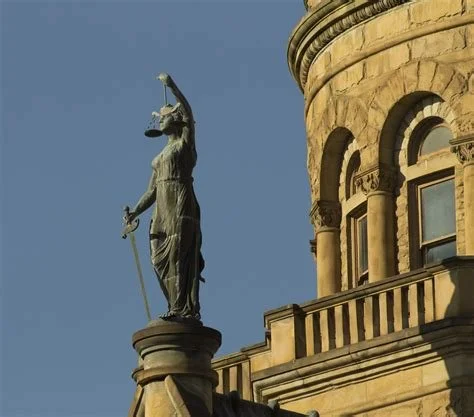
The saying, “no one is above the law” has been repeated with abandon the past few years in the United States. The incarceration of former French president, Nicolas Sarkozy, should remind us what no one being above the law really means.
The saying, “no one is above the law” has been repeated with abandon the past few years in the United States. It boomed during the Biden administration when multiple courts found Donald Trump and his supporters to have broken various laws. The idea behind the saying was simply one of equality before the law, whether accepted as judicial norm, constitutional principle, or just plain fairness in our democracy. Now with Trump back in office, the saying seems to have silently morphed into “no one is above the law but me.”
Convictions have been overturned on appeal, damages reduced, the Supreme Court docket jammed for emergency opinions expanding presidential powers. The abuse of pardons has become so heinous and blatantly political, Trump allies now have a literal ‘get out of jail free’ card. Not to mention the dogged prosecution of any and all of Trump’s opponents. 47 has gotten the best deal a dictator could ask for: the transformation of presidential power into authoritarian power. A complicit Republican bloc in Congress and in the Federal courts have been more than happy to hand this power over to him and his Justice Department.
Meanwhile the incarceration of former French president, Nicolas Sarkozy, should remind us what no one being above the law really means. Sarkozy served as president from 2007 to 2012 and was recently convicted of conspiring to accept campaign funds from Muammmar Qaddafi, the former president of Libya. On his way to begin a five-year prison sentence, Sarkozy was caught on camera leaving his lofty apartment in the 16th arrondissement of Paris. His wife and former model Carla Bruni (who shares a background and look with Melania Trump) walked solemnly at his side. It was a picture-perfect moment. Sarkozy appeared and spoke not as a disgraced fallen leader but as the self-purported victim of the justice system (sharing a similar stance with Trump). The system simply rendered a verdict he didn’t like.
It is a testament to the strength of the French republic that not even a former president can be spared a guilty conviction and prison sentence for his crime. This is not to suggest the French judicial system is without its flaws. Many in France fairly asked whether the trial was politically motivated. But regardless of whatever motive brought Sarkozy before the court, the fact remains he was found to have broken the law by trying to get a foreign dictator to sponsor his presidential campaign. Trump has probably done that and worse, and despite several guilty verdicts, still walks free.
What Sarkozy’s trial also proved was that indeed no one—at least not French presidents—is above the law. Back in the United States, however, that prospect seems remotely in the past. Any sense of justice now is more likely to come from your political allies in power. And depending on which political party they are could make you feel either vindicated or victimized. Either way, for those in power, the law is now beneath them.

Glass Houses
It’s pretty easy to mock the French government right now. However, throwing proverbial stones has already gotten Americans, Democrats and Republicans alike, into enough serious trouble. Perhaps it’s time for them to build a more solid house than one made of glass.
It’s pretty easy to mock the French government right now. Sébastien Lecornu was prime minister for barely a month. By the time he named all the members of his cabinet, it collapsed fourteen hours later and broke another record of shortest-lived French governments.
Lecornu’s immediate predecessor had lost a confidence vote over his budget proposals and the “Block Everything” social movement that opposed them. Lecornu fared no better. He was just the latest in line—eighth to be exact—of prime ministers under President Emmanuel Macron whose legitimacy is disappearing as quickly as members of his party. Then parliament had a sense of déjà vu when Macron promptly reappointed Lecornu as prime minister. How long the Lecornu II government will last is anyone’s guess.
The American press is right to call it political chaos, crisis, deadlock, disarray, impasse, turmoil, so on and so on. Yet never has the expression about people in glass houses throwing stones been more appropriate. Members of the Congress have shut the United States government down once again.
While both the French and American political circumstances stem from fights over the national budget in their respective legislatures, only the US government actually shut down. This curtails services provided by Federal agencies as well as the pay of their employees. Members of Congress, ironically, still get paid even when they don’t work toward a compromise or anything else.
In France, however, the government continues to operate and public employees still get paid for their work while political battles play out. That doesn’t mean France can continue to ignore its budget approval process. But the country’s public service and citizens are not hostage to any party’s political scores. Meanwhile the US is on its eleventh government shutdown in history, the last three of which have been under Donald Trump. And like the situation in France, the end of the US government shutdown is anyone’s guess.
Americans can blame the shutdown on whomever they want but it might help instead to look to how other countries face a budgetary crisis. The French government is definitely in one, but at least it’s still open. And though Americans don't have a parliamentary system, they could still demand the impeachment—a vote of no confidence of sorts—of any president or lawmaker willing to shut the US government down. In the very least, they shouldn’t think their political leaders are somehow more righteous than French ones.
Benjamin Franklin is credited with publishing a variation of “people in glass houses shouldn’t throw stones.” The origins of the adage trace back even further to the 14th century to Chaucer’s Troilus and Criseyde. Written in Middle English, the poem uses the word of French origin for glass, verre, since it rhymed with werre, also from Old French meaning war or conflict: “And for-thy, who that hath an heed of verre, Fro cast of stones war him in the werre!” Flash forward to the 20th century, Billy Joel released an album titled Glass Houses whose cover featured the singer about to throw a stone at a glass house, his own in fact. (The album also features a song in French, C’était toi.) The original message about hypocrisy may have given way to one about real danger.
Indeed, throwing proverbial stones has already gotten Americans, Democrats and Republicans alike, into enough serious trouble. Perhaps it’s time for them to build a more solid house than one made of glass.
A Christmas miracle for the French government
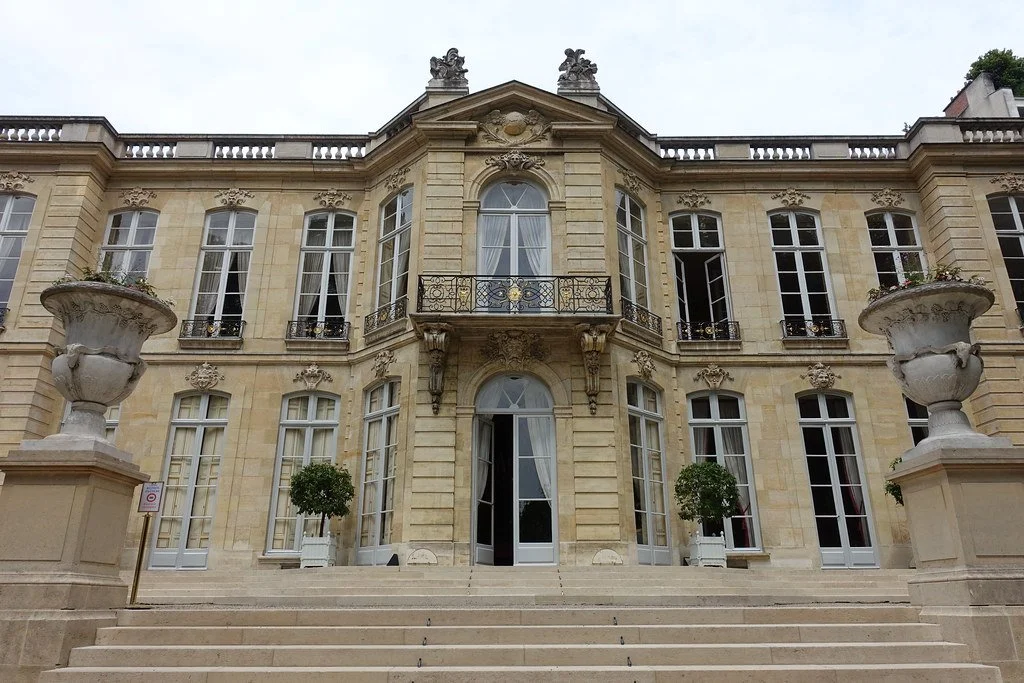
Emmanuel Macron promised a new government by December 25 and it was nothing short of a Christmas miracle.
Emmanuel Macron promised a new government by December 25 and it was nothing short of a Christmas miracle. When Macron dissolved the National Assembly back in June, he gambled that voter dissatisfaction would translate into more representatives in the lower house of parliament from his own party. Macron took a page right out of the playbook of France’s historical strongmen—Napoleon, Louis Napoleon, Mac Mahon, de Gaulle—who similarly turned to voters for support of their initiatives. At least Macron followed the constitution when he called for fresh elections. Many questioned the wisdom of his choice. With just a little over two years until his final term ends, time’s running out for Macron to turn around public opinion and assure a positive legacy to his presidency.
It was a gamble that didn’t pay. Instead of returning more representatives to expand support for his policies, the center caved in. Marine Le Pen’s far-right party sent the highest number of representatives to the National Assembly in a first for the Fifth Republic. Macron responded by naming a prime minister from the more moderate right, Michel Barnier, who appealed to no one. The left and far-left parties, which also saw gains in the latest legislative elections, were furious for not getting more seats at the council of ministers’ table. When a budget bill came up in the chamber last month, they called for a vote of no confidence in the prime minister. With no majority party backing him, Barnier became the shortest-serving prime minister of the Fifth Republic, another historical first.
Is Macron chastened by the whole affair? Perhaps, but it doesn’t show. A returning cast of characters, most of whom are seasoned public officials, including François Bayrou, the new prime minister. Also joining the government are some holdovers from the current cabinet. The French ‘government’ is roughly analogous to the American president’s administration. And by comparison, what’s transpiring in France at least demonstrates a certain strength of the French constitution. It has withstood the machinations of a president whose ambition tops his skill. And although it looks like the government has a revolving door of ministers in the late Macron presidency, it’s a least a door to a representative government.
Meanwhile, Americans are gearing up for a new presidential cabinet that’s beginning to look more like a country club. Trump’s picks so far include fellow billionaires whose ideals of public service are how to make the public work for the private sector. No government experience necessary seems like the surest qualification. Not even ethics violations or criminal allegations are a problem. So long as you can pay to play, and play up to Trump’s ego, you’ve got a shot at being one of the president’s men or women. And let’s face it, it’s mostly men.
The process by which Trump is planning to get who he wants in the administration is questionable, but also constitutional. Even if he uses recess appointments to get around any senators who merely suggest questioning the qualifications of his nominees, it passes constitutional muster. But it’s not representative of the American people. The incoming Trump administration will be a crew more at home at Mar-a-Lago, or prison, than in the White House.
In France, the new government might not be perfect. And with any luck, it’ll last at least until next Christmas. However, it represents the French people better than what Americans can expect in the next Trump administration.